Take your digital marketing to the next level with data-driven strategies and innovative solutions. Let’s create something amazing together!
A few years ago, ranking on Google’s first page was the finish line. You optimized your keywords, built some backlinks, wrote a meta description, and waited for traffic to roll in. That playbook still matters — but it’s no longer the whole story.
Today, people don’t just “Google” things. They ask ChatGPT to compare products. They ask Google’s AI Overview a question and never click a single blue link. They ask Siri or Alexa for the nearest service provider. Search has quietly split into three overlapping worlds: traditional search engines, AI-generated answers, and generative chat platforms.
That’s where SEO, AEO, and GEO come in. At Technivore, our team in Lahore works with businesses every day who are confused about which of these actually matters for them — and the honest answer is: probably all three, just in different proportions depending on your industry. This guide breaks each one down in plain language, shows you where they overlap, and gives you a practical starting point.
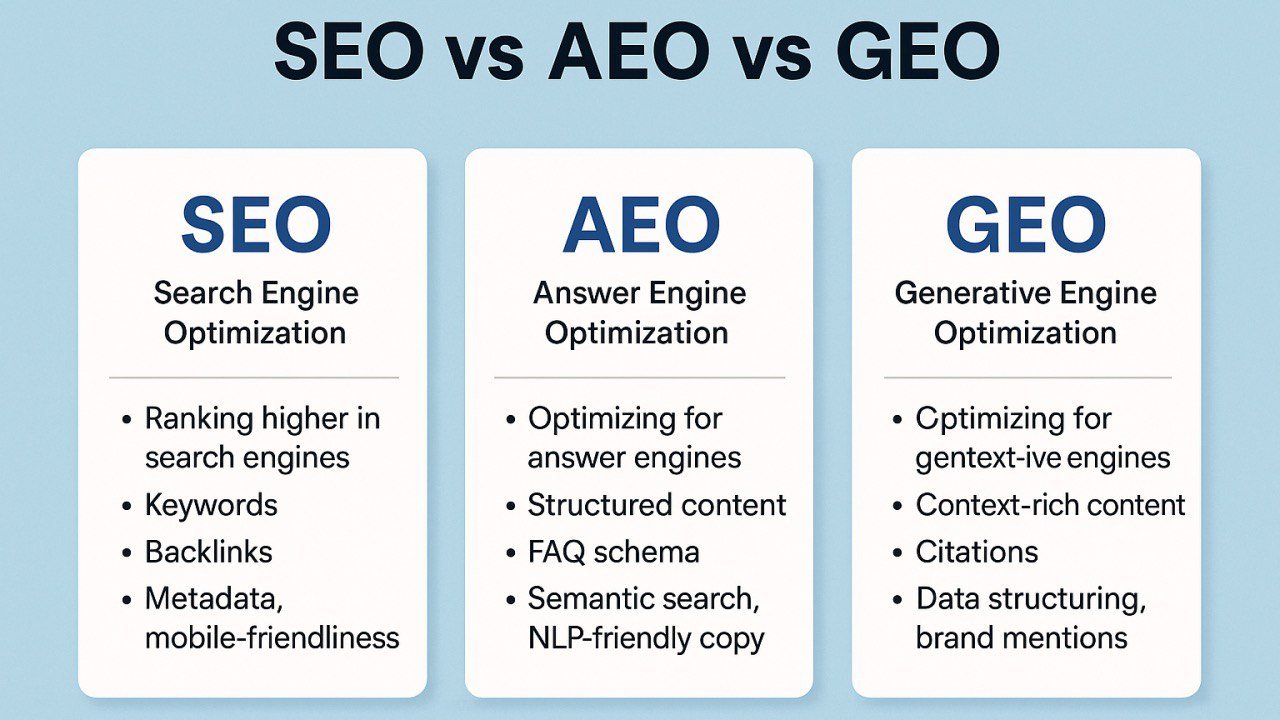
SEO is the practice of optimizing a website so it ranks higher in traditional search engine results — think Google, Bing, or Yahoo. It’s the foundation almost everyone starts with, and for good reason: it’s been around since the late 1990s and still drives the majority of website traffic for most businesses.
SEO covers a wide range of activities:
The goal of SEO is simple: when someone types a query into a search engine, your website shows up as high as possible in the list of results. Higher rankings generally mean more clicks, more visitors, and — if the rest of your site is doing its job — more customers.
SEO is not going away. But it is changing shape, because search engines themselves are changing shape.
AEO is the practice of optimizing content so it gets pulled directly into “answer boxes” — Google’s featured snippets, People Also Ask sections, voice assistant replies, and AI Overviews. Instead of optimizing purely to rank in a list of ten blue links, you’re optimizing to become the answer itself.
Think about how often you ask Google a direct question — “what is the best time to post on Instagram” or “how long does a passport renewal take in Pakistan” — and get your answer instantly, without clicking anything. That’s AEO in action. The business whose content got pulled into that box didn’t necessarily rank #1 overall; they simply structured their content in a way that was easy for the search engine to extract and present as a direct answer.
AEO tends to reward content that:
The tricky part about AEO is that it can reduce click-through traffic — the user gets their answer without visiting your site. But it builds brand visibility and trust at scale, especially for local businesses and service providers who want to appear as the “go-to” source for their niche.
GEO is the newest of the three, and it’s specifically about optimizing your content to be referenced, cited, or summarized by generative AI tools — ChatGPT, Google’s Gemini, Perplexity, Claude, and similar platforms. When someone asks an AI assistant “what’s the best digital marketing agency in Lahore” or “compare these three CRM tools,” the AI pulls information from across the web to construct its answer. GEO is about making sure your business is one of the sources it pulls from.
This is a genuinely new discipline because generative engines don’t work like traditional search crawlers. They synthesize information from multiple sources into a single conversational response, and they tend to favor:
GEO overlaps heavily with AEO, but the target is different. AEO aims for a snippet box on a search results page. GEO aims for a mention or citation inside an AI-generated conversation, where the user may never see a traditional search results page at all.
LLMO is closely related to GEO but focuses specifically on how large language models are trained and how they “remember” or represent your brand. While GEO is often about real-time retrieval (the AI searching the live web for an answer), LLMO is about influencing what a model already knows from its training data.
In practice, LLMO means building a consistent, factual, well-documented presence about your brand across the internet — Wikipedia-style consistency, structured data, press mentions, and clear “about” information — so that when an AI model has learned from a broad snapshot of the web, your business is represented accurately within it.
For most small and mid-sized businesses, LLMO and GEO blend together in daily practice: publish clear, consistent, well-structured, factual content about who you are and what you do, everywhere your audience might find you.
| Factor | SEO | AEO | GEO / LLMO |
|---|---|---|---|
| Target platform | Google, Bing search results | Snippets, voice assistants, AI Overviews | ChatGPT, Gemini, Perplexity, Claude |
| Goal | Rank high in results list | Become the direct answer | Get cited or referenced in AI responses |
| Content style | Keyword-optimized pages | Short, direct Q&A format | Structured, factual, authoritative |
| Traffic outcome | Click-through to website | Visibility, sometimes fewer clicks | Brand mention, often no click at all |
| Key tools | Keyword research, backlinks | Schema markup, FAQ pages | Structured data, consistent brand facts |
None of these replace the others. They’re layers. A well-optimized page today should be readable by a human, structured for a search engine, direct enough to be pulled into an answer box, and factual enough for an AI model to cite confidently.
Pakistan’s digital economy is growing fast, and search behavior here is shifting just as quickly as anywhere else. More people are using voice search on mobile devices, more professionals are turning to ChatGPT for quick research before making a purchase decision, and Google’s AI Overview is already appearing for a large share of everyday queries — including local ones like “best restaurants in Lahore” or “affordable web development company near me.”
If your business only optimizes for classic SEO, you’re competing for a shrinking slice of “click-through” attention. If you ignore SEO entirely and chase only AI visibility, you lose the steady, reliable traffic that still comes from organic search results. The businesses that will win over the next few years are the ones optimizing across all three layers at once.
At Technivore, based in Lahore, this is exactly the shift we help clients navigate — building websites and content strategies that perform on Google’s results page today, while also being structured to show up correctly when a customer asks an AI assistant for a recommendation tomorrow.
SEO, AEO, and GEO aren’t competing strategies — they’re three lenses on the same goal: making sure your business is visible, credible, and easy to find, no matter how someone chooses to search. Google isn’t disappearing, but the way people ask questions is expanding well beyond a search bar.
For businesses in Lahore and across Pakistan, this is the right moment to build a content and SEO strategy that works across all three — before competitors figure it out first. Technivore helps businesses do exactly that: combining solid technical SEO with the structured, answer-ready content that both traditional search engines and AI platforms are increasingly rewarding.
What is the difference between SEO and AEO? SEO focuses on ranking your website in a list of search results, while AEO focuses on getting your content selected as the direct answer shown in a snippet, voice reply, or AI Overview.
Is GEO replacing SEO? No. GEO is an addition to SEO, not a replacement. Search engines and AI platforms are increasingly overlapping, and businesses need both to stay visible.
How does LLMO affect small businesses? LLMO matters most for brand consistency — making sure your business information is accurate and well-documented across the web so AI models represent you correctly when asked.
Do I need a specialized agency for AEO and GEO? Not necessarily, but it helps to work with a team that understands structured content, schema markup, and how generative AI tools retrieve information — which is exactly where an experienced digital marketing partner like Technivore adds value.